Table of Content
Open the entire book: In PDF Format  In ePub Format
Front Matter
Introduction
Section I. How Evolution Produced Writing Humans and How Writing Humans Remade Their World
Chapter 1. The Peculiar Emergence of Homo Scribens
Chapter 2. Communication Within and Beyond the Skin Barrier
Chapter 3. Letters and the Social Grounding of Differentiated Genres
Chapter 4. The Writing of Social Organization and the Literate Situating of Cognition: Extending Goody’s Social Implications of Writing
Chapter 5. Revisiting the Early Uses of Writing in Society Building: Cuneiform Culture and the Chinese Imperium
Section 2. Writing and Knowledge
Chapter 6. Local and Distant Knowledges, Local and Distant Minds
Chapter 7. What Literate Societies See: The Methodical Gaze of Genres
Chapter 8. Making the World Scientifically Thinkable: Inscribing Experience Methodically and Its Cognitive Consequences
Chapter 9. The Loneliness of the Long-Distance Writer: The Growing, Unsatisfiable Hunger of Connection
Section 3. Nurturing Homo Scribens: Puzzles of Writing Instruction
Chapter 10. Writers Use Language, but the Teaching of Writing Requires More than the Teaching of Language
Chapter 11. The Value of Empirically Researching a Practical Art
Chapter 12. A? Developmental? Path? To? Text? Quality?
Chapter 13. What Does a Model Model? And for Whom?
Section 4. The Ethics and Values of Writing
Chapter 14. Equity Means Having Full Voice in the Conversation
Chapter 15. Schooling for Life, All Lives: Opportunity, Dilemma, Challenge, Critical Thought
Chapter 16. Paying the Rent: Languaging Particularity and Novelty
Chapter 17. Reproduction, Critique, Expression, and Cooperation: The Writer’s Dance in an Intertextual World
Chapter 18. The Ethical Poetry of Academic Writing
Section 5. Guesses at Unknown Futures
Chapter 19. Looking Backwards Towards the Future
About the Author
Charles Bazerman is Distinguished Professor Emeritus of Education at the University of California Santa Barbara. He is founder and former chair of the International Society for the Advancement of Writing Research and former chair of the Conference on College Composition and Communication. He has been a visiting professor in Portugal, Denmark, the Czech Republic, France, China, Hong Kong, Singapore, Nepal, Chile, Mexico, Brazil, and the US. His books include How I Became the Kind of Writer I Became, A Rhetoric of Literate Action, A Theory of Literate Action, The Languages of Edison’s Light, Shaping Written Knowledge, The Informed Writer, The Handbook of Research on Writing, What Writing Does and How It Does It, and Lifespan Development of Writing Abilities.
Practices & Possibilities
Series Editors: Aimee McClure, Clarke University; Kelly Ritter, Georgia Institute of Technology; Aleashia Walton, University of Cincinnati; and Jagadish Paudel, University of Texas at El Paso
This book is available in whole and in part in Adobe’s Portable Document Format (PDF). It is also available in a low-cost print edition from our publishing partner, the University Press of Colorado.
Copyright © 2024 Charles Bazerman. This work is licensed under a Creative Commons Attribution-Noncommercial-No Derivative Works 4.0 International License. 298 pages, with notes, illustrations, and bibliographies. This book is available in print from University Press of Colorado as well as from any online or brick-and-mortar bookstore. Available in digital formats for no charge on this page at the WAC Clearinghouse. You may view this book. You may print personal copies of this book. You may link to this page. You may not reproduce this book on another website. For permission requests and other questions, such as creating a translation, please contact the copyright holder.




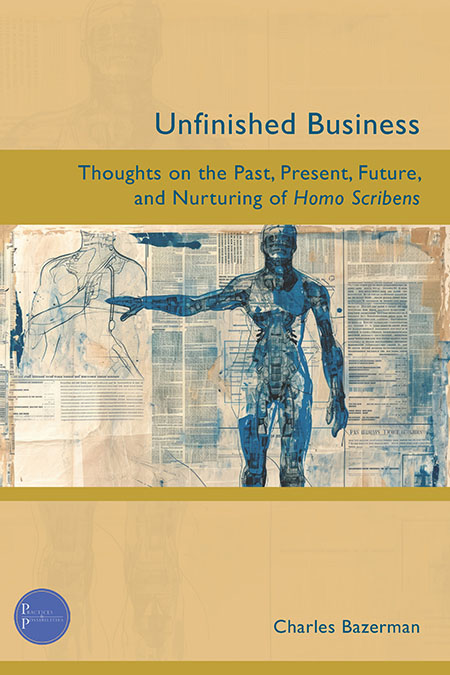 In Unfinished Business, Charles Bazerman considers long-standing puzzles in writing studies, from the most fundamental ideas about humans as writers and writing as constituting modern society to the most practical issues of curriculum and teaching. Together, the chapters provide a broad vision of the importance, role, consequences, and means of writing. The opening cluster of chapters places Homo sapiens’ capacity to write within the biological and cultural evolutionary arc. The second cluster of chapters focuses on how writing has extended and transformed our knowledge with major consequences for us as societies and individuals. The third cluster considers how we go about teaching this increasingly important skill that gives people voice in the literate world. The fourth reflects on the values and ethical concerns that pervade the practice and teaching of writing. In his final chapter, Bazerman speculates about where writing and writing instruction may go in the rapidly changing future.