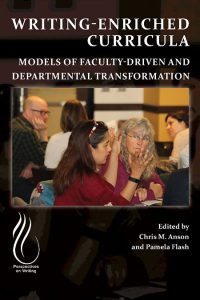
This edited collection explores theoretical and practical applications of the Writing-Enriched Curriculum (WEC) approach, an innovative and sustainable alternative to writing across the curriculum and writing in the disciplines. The collection’s purpose is to inform writing program administrators, teachers, scholars, and university officials about the model’s potential to transform the way writing is used and supported across courses and curricula in higher education. To this end, contributors offer theoretically grounded accounts of WEC or WEC-like programs and localized research that demonstrate the model’s impact and effectiveness within and across institutional contexts. The book has three sections: “The WEC Approach,” which describes the theoretical and practical basis informing WEC programs; “Accounts of Departmentally-Focused Implementation,” which considers specific campus initiatives to build WEC programs; and “Extensions and Contextual Variation,” which showcases ways in which the approach has led to cross-unit collaborations and varieties of implementation. Contributors bring scholarly and administrative experience to their investigations of WEC, and each has a track record of research and publication. Writing-Enriched Curricula: Models of Faculty-Driven and Departmental Transformation is the first collection dedicated to this innovative and tested approach.
Chris Anson is Distinguished University Professor, Alumni Association Distinguished Graduate Professor, and Director of the Campus Writing and Speaking Program at North Carolina State University, where he teaches graduate and undergraduate courses in language, composition, and literacy and works with faculty across the disciplines to enhance writing and speaking instruction. He has published 19 books and 140 articles and book chapters relating to writing and has spoken widely across the United States and in 33 other countries. He has received numerous teaching awards and has participated in over $2 million in grants. He is Past Chair of the Conference on College Composition and Communication and Past President of the Council of Writing Program Administrators, and is vice-chair of the International Society for the Advancement of Writing Research. His full c.v. is at www.ansonica.net.
Pamela Flash is Director of Writing Across the Curriculum, Co-Director of the Center for Writing, and Affiliate Graduate Faculty for the Literacy and Rhetorical Studies Minor at the University of Minnesota where she has taught and has administered teaching-oriented programming since 1991. Flash is founding director of the University of Minnesota’s Writing-Enriched Curriculum Program. She served as chair of the International Writing Across the Curriculum Conference (IWAC) in 2014 and has consulted extensively with colleges and universities interested in establishing or sustaining WAC programs and in adapting the WEC model to their institutional contexts. Her work in developing the WEC model was generously supported by a $1M grant from the Bush Foundation, and she currently serves as Co-PI in a $3M multi-institutional NSF grant investigating the impact of brief writing prompts on conceptual learning in large-enrollment STEM courses.
Series Editors: Rich Rice, Texas Tech University; Heather MacNeill Falconer, University of Maine; and J. Michael Rifenburg, University of North Georgia
This book is available in whole and in part in Adobe’s Portable Document Format (PDF). It is also available in a low-cost print edition from our publishing partner, the University Press of Colorado.